



Professional voice-over vs. artificial intelligence
Little by little, artificial intelligence has been infiltrating our lives, and what seemed impossible a few years ago is now part of our daily routine, whether they are virtual assistants, technologies that can create incredible images, write texts in seconds, or defeat the great chess masters. One of the industries that is already being transformed by the advances of artificial intelligence is the voice-over industry.
The entire production process has changed and voice artists feel threatened by these new technologies. Some even think that this is the beginning of the end, and that voice-over with human voices could disappear completely in the not-too-distant future.

It is true that a few years ago it was unthinkable to replace a human voice with a 'computer voice', because there were still many errors, and the voices could sometimes be incomprehensible and even annoying. The same was true for voice recognition systems.
However, today significant advances have been made in this field, and although perfection has not been achieved, there are some examples of voices so realistic that they could deceive more than one person. One of the great advantages of artificial intelligence is that you can try different voices before choosing the most suitable one for your course or script, which is very helpful in overcoming the great challenge of finding the right person.
In addition, there is the possibility of using editing tools and special effects that in the past would have required a whole technical team. Now, a single sound engineer with some applications and plugins can introduce effects or change the tone and texture of the voice with just a few clicks. To conclude, there is the matter of savings. The production of recordings with artificial intelligence has a significantly lower cost than with human voiceover, so it is not surprising that more and more companies are leaning towards this solution.
There is no doubt that artificial intelligence in voice acting has come to stay, which does not mean that voice artists will not have their place. What is certain is that quality will be their greatest competitive advantage, so they will have to work to make their recordings excellent and ensure that their voice makes them distinctive and unique.
Voice-over in an e-Learning course
If you are in the process of creating an e-Learning course and need to choose between a professional voice-over or one from artificial intelligence, here are some steps you can follow:
-
Identify the goal of your course: What do you want to convey through your course? Do you need the message to be clear and precise, or do you just need a voice to accompany your videos and presentations? If your goal is to convey a message effectively and with emotion, you will likely need a professional voiceover.
-
Consider your audience: Who are the people that will follow your course? Do they need a voice that can adapt to different tones and dialects, or is a neutral voice sufficient? If your audience is broad and diverse, you may need a voice that can adapt to different tones and dialects. In this case, a professional voiceover may be more suitable.
-
Evaluate your resources: What are your financial and time resources for this project? If you have a limited budget or need a voice quickly, AI can be a cheaper and faster option. However, if you can dedicate more time and resources, a professional voice-over can provide more convincing results.
-
Compare the results: Before making a decision, it is important to compare the results you can achieve with a professional voiceover and one from AI. You can listen to demos of different voices and evaluate which one best fits your needs.
It is important to carefully evaluate your goals, your audience, and your resources before making a decision.
Next, we present to you an AI voice generator that you can consider. However, it is important to research different options and compare them to find the tool that best fits your needs.
Murf.ai is an AI voice generator that offers more than 120 realistic voices in 20 different languages. With this tool, you can easily convert your text into speech with just a couple of clicks. Additionally, it is very user-friendly, so you don't need any technical knowledge to use it.

Revoicer, on the other hand, is an emotion-based AI voice generator. This means you can bring your text to life with a voice that captures the emotion you want to convey. Additionally, Revoicer is an online tool, so you can access it from anywhere with an internet connection.
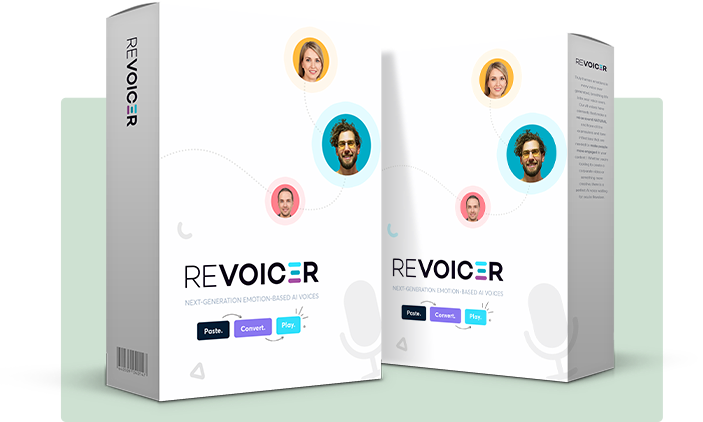
Both tools are very useful for creating the perfect AI voice-over for your e-Learning projects. However, it is important to keep in mind that the quality of the voice generated by AI can vary depending on the tool you use. Therefore, it is advisable to try different options to find the one that best suits your needs.
In addition to Murf.ai and Revoicer, there are other options for AI-generated voice tools available on the market. Each AI voice generator has its own advantages and disadvantages, so it is important to compare them before making a decision.
If you need to choose which is the best voice option for your e-Learning course, contact us. We have both solutions and we are here to help.